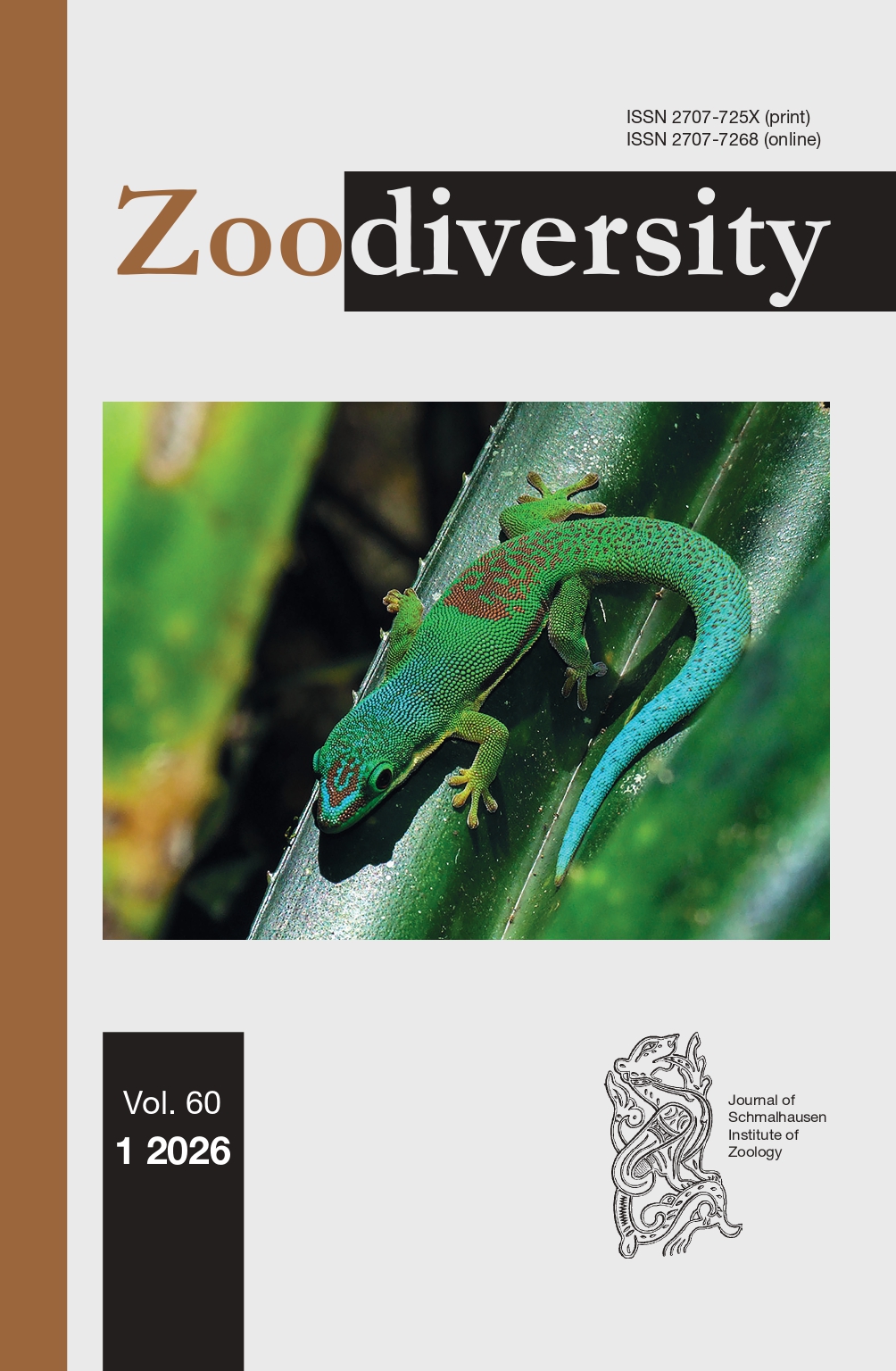
Reproductive traits of the São Nicolau wall gecko, Tarentola nicolauensis (Gekkota, Phyllodactylidae)
Abstract
This study provides information on main reproductive characteristics of Tarentola nicolauensis. Egg-laying behavior, clutch size, reproductive effort, size, weight, incubation period and post-oviparous weight loss of eggs as well as hatching characteristics of offspring in captivity were described. It was found that Tarentola nicolauensis produces relatively few clutches in the course of a laying season and that the majority of clutches contain a single large egg rather than two comparatively small eggs. Hatching size and hatching weight of the hatchlings correspond to the egg sizes. These reproductive traits are characteristic of many endemic species of Tarentola of the Cape Verde Islands. Studies on life history and ecology of animals are important for species conservation. Such studies are unfortunately limited for reptiles. Therefore, studies in captivity are important and complement field studies.
References
Bischoff, W. 1985. Die Herpetofauna der Kanarischen Inseln. II. Die Geckos der Gattung Tarentola. Herpetofauna, 7 (35), 27-34.
Bischoff, W., Nettmann, H. K. & Rykena, S. 1979. Ergebnisse einer herpetologischen Exkursion nach Hierro, Kanarische Inseln. Salamandra, 15 (3), 158-175.
Carranza, S., Arnold, E. N., Mateo, J. A. & Geniez, P. 2002. Relationships and evolution of the North African geckos, Geckonia and Tarentola (Reptilia: Gekkonidae), based on mitochondrial and nuclear DNA sequences. Molecular, Phylogenetics & Evolution, 23, 244-256.
https://doi.org/10.1016/S1055-7903(02)00024-6
Fitch, H. S. 1985. Variation in clutch and litter size in new world reptiles. The University of Kansas Museum of Natural History, Miscellaneous Publication, 76, 1-76.
https://doi.org/10.5962/bhl.title.16254
Gamble, T., Bauer, A. M., Greenbaum, E. & Jackmann, T. R. 2008. Out of the blue: a novel, trans-Atlantic clade of geckos (Gekkota, Squamata). Zoologica Scripta, 37, 355-366.
https://doi.org/10.1111/j.1463-6409.2008.00330.x
Grünewald, G., Höller, E. & Stranz, D. 1983. Länder und Klima: Afrika. Wiesbaden: F. A. Brockhaus.
Henle, K. 1990. Life history - Evolution bei Echsen. In: Streit, B., ed. Evolutionsprozesse im Tierreich Basel: Birkenhäuser, 183-198.
https://doi.org/10.1007/978-3-0348-5214-2_11
Hielen, B. 1991. Untersuchung zur temperaturabhängigen Geschlechtsbestimmung und Fortpflanzungsbiologie bei Geckos der Gattungen Tarentola und Cyrtopodion. MSc thesis, Universität Bremen.
Hielen, B. 1993. Unterschiedliche Fortpflanzungsstrategien bei Geckos der Gattung Tarentola, Gray, 1825. Salamandra, 28 (3/4), 179-194.
Joger, U. 1984. Taxonomische Revision der Gattung Tarentola (Reptilia: Gekkonidae). Bonner Zoologische Beiträge, 35, 129-174.
López-Alcaide, S. & Macip-Ríos, R. 2011. Effects of climate change in amphibians and reptiles. In: Grillo, O. and Venora, G., eds. Biodiversity loss in a changing planet. Rijeka (InTech), 163-184.
Mateo, J. A., Geniez, P., Veiret, P. & Lopez Jurdao, L. F. 2022. Reptiles de Macaronesia, Azores, Madeira, Salvajes, Canarias, Cabo Verde y Litoral Sáhara Atlántico. Madrid: Asociatión Herpetológica Españiola.
Meiri, S., Avila, L., Bauer, A. M., Chapple, D. G., Das, I., Doan, T. M., Doughty, P., Ellis, R., Grismer, L. L., Kraus, F., Morando, M., Oliver, P., Pincheira-Donoso, D., Ribeiro-Junior, M. A., Shea, G., Torres-Carvajal, O., Slavenko, A. & Roll, U. 2020. The global diversity and distribution of lizard clutch sizes. Global Ecology and Biogeography, 2020, 1-16.
https://doi.org/10.1111/geb.13124
Nettmann, H. K., & Rykena, S. 1985. Verhaltens- und fortpflanzungsbiologische Notizen über kanarische und nordafrikanische Tarentola-Arten. Bonner Zoologische Beiträge, 36 (3/4), 287-305.
Novosolov, M., & Meiri, S. 2013. The effect of island type on lizard reproductive traits. Journal of Biogeography, 40, 2385-2395.
https://doi.org/10.1111/jbi.12179
Novosolov, M., Raia, P., & Meiri, S. 2013. The island syndrome in lizards. Global Ecology and Biogeography, 22, 184-191.
https://doi.org/10.1111/j.1466-8238.2012.00791.x
Rösler, H. 2005. Vermehrung von Geckos. Offenbach: Herpeton, Verlag Elke Köhler.
Rösler, H. 2020 a. Vergleichende Untersuchungen zur extrakorporalen Entwicklung weich- und hartschaliger Eier von Geckos (Squamata: Gekkota): 8. Auswertung der Befunde zu den Fortpflanzungsmerkmalen der sieben Geckoarten. Sauria, 42 (4), 21-41.
Rösler, H. 2020 b. Gelegegröße und ihre Variabilität bei Geckos (Squamata: Gekkota). Vernate, 39, 113-132.
Rösler, H. 2021. Oologische Studien an Geckos (Squamata: Gekkota): Morphometrie und Wasserhaushalt im Entwicklungsverlauf weich- und hartschaliger Geckoeier. Vernate, 40, 135-213.
Rösler, H. 2022. Akzente der Fortpflanzungsbiologie oviparer Geckos (Squamata: Gekkota) - Charakter, Evolution, Phylogenie. Vernate, 41, 91-212.
Rösler, H. & Wranik, W. 2008. Bemerkenswerte endogene Farbveränderung der Eischale von Chioninia delalandii (Duméril & Bibron, 1839) (Reptilia: Sauria: Scincidae). Der Zoologische Garten (NF), 78, 43-48.
https://doi.org/10.1016/j.zoolgart.2008.09.005
Rösler, H. & Wranik, W. 2009. Kurzbeschreibung der Haltung und Vermehrung von Chioninia delalandii (Duméril & Bibron, 1839) im Terrarium (Reptilia: Sauria: Scincidae). Sauria, 31 (1), 41-43.
https://doi.org/10.1016/j.zoolgart.2008.09.005
Rösler, H. & Wranik, W. (im Druck). Vergleichende Studien fortpflanzungsbiologischer Merkmale von Mauergeckos (Tarentola Gray, 1825) der Kanarischen Inseln und Kapverden (Makaronesien).
Schwarz, R. & Meiri, S. 2017. The fast-slow life-history continuum in insular lizards: a comparison between species with invariant and variable clutch sizes. Journal of Biogeography, 44 (12), 1-8.
https://doi.org/10.1111/jbi.13067
Shine, R. 1992. Relative clutch mass and body shape in lizards and snakes: is reproductive investment constrained or optimized? Evolution, 46 (3), 828-833.
https://doi.org/10.1111/j.1558-5646.1992.tb02088.x
Ualiyeva, D., & Khan, Z. 2022. Reptiles extinction: a perspective on the current heat wave. Health, 5 (2): 1087.
Vasconcelos, R., Perera, A., Geniez, P., Harris, D. J. & Carranza, S. 2012. An integrative taxonomic revision of the Tarentola geckos (Squamata, Phyllodactylidae) of the Cape Verde Islands. Zoological Journal of the Linnean Society, 164, 328-360.
https://doi.org/10.1111/j.1096-3642.2011.00768.x
Vitt, L. J. & Congdon, J. D. 1978. Body shape, reproductive effort, and relative clutch mass in lizards: resolution of a paradox. The American Naturalist, 112, 595-607.
https://doi.org/10.1086/283300
Wranik, W. 2007. Faunistic Survey Serra Malaguetta Natural Park (Santiago Island), Monte Gorodo Natural Park (São Nicolau Island), Repùblica de Cabo Verde. Part I: Vertebrates. 19 October-9 November 2006. Final Report. Rostock: Universität Rostock.
Wranik, W. & Rösler, H. 2007. Reptilia (Reptiles). In: Wranik, W. ed. Faunistic Survey Serra Malaguetta Natural Park (Santiago Island), Monte Gorodo Natural Park (São Nicolau Island), Repùblica de Cabo Verde. Part I: Vertebrates. 19 October-9 November 2006. Final Report. Rostock: Universität Rostock, 155-284.